
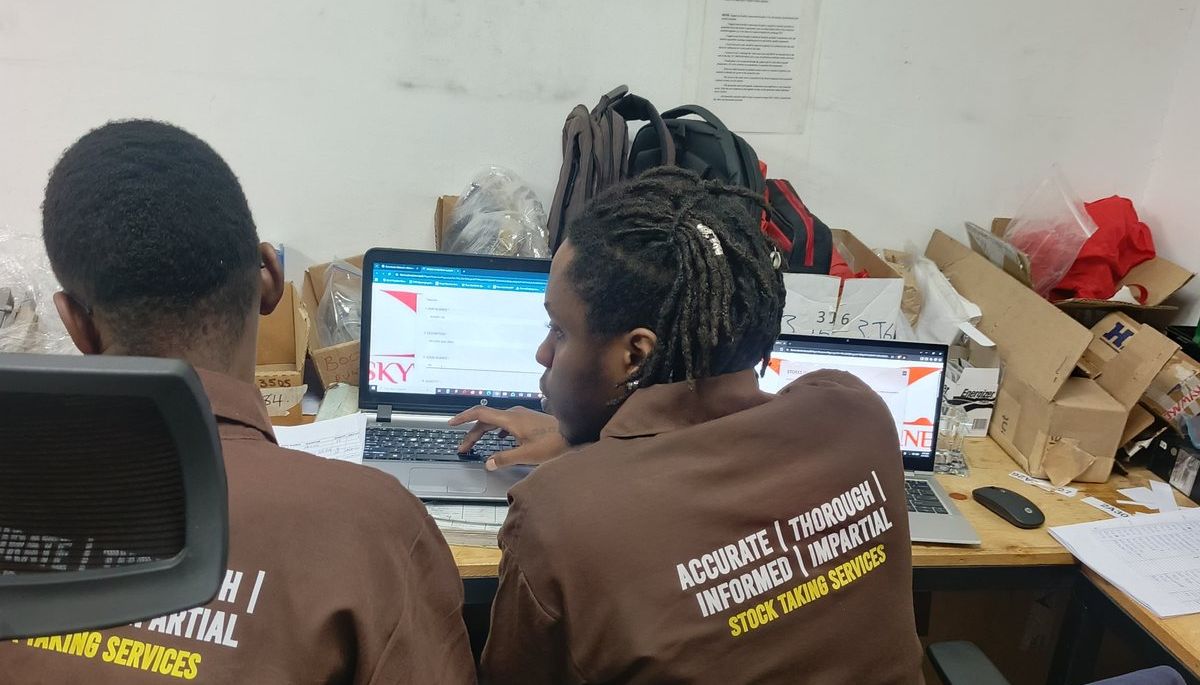
What auditors actually want from your year-end count
The count itself is half of it. What auditors test is whether the number can be evidenced.
Closing inventory sits directly in the cost of sales calculation. Get it wrong and both the balance sheet and the profit figure are wrong with it. That is why auditors spend disproportionate time on stock, and why “we counted it” is not, on its own, an answer.
What the audit tests is not whether you counted. It is whether the figure you arrived at can be evidenced by somebody who was not there.
Cut-off
The first thing tested, and in the year-end counts Stock Handlers Solutions attends, the most common source of adjustments. Cut-off is the question of which transactions belong before the count and which belong after.
Goods received on the last day of the year but not yet entered. Goods invoiced to a customer but still on your floor. Stock in transit between branches. Returns sitting in a receiving bay with no paperwork. Each of these can be legitimately included or excluded; what cannot be defended is treating them inconsistently, or counting something that has already been sold.
The practical control is to stop movement for the duration of the count where that is possible, and where it is not, to document every movement during the count window with its timing, so each can be allocated to the correct side of the line.
Count documentation
Auditors are required to obtain evidence, and a final stock valuation spreadsheet is not evidence of a count. What supports the figure is the record of the count itself.
- Count sheets showing what was counted, where, by whom and when
- Evidence that every location was covered and none counted twice
- Recounts of flagged items, documented as recounts
- The original count data, retained in the state it was captured — not only the adjusted final figures
- A clear trail from the count sheets through to the number in the accounts
That last one catches people out. The count produces one figure, adjustments are made for perfectly good reasons, and the number in the accounts is a third figure with nothing connecting it back. Every adjustment between the floor and the ledger needs a reason attached to it.
Independence of the counters
This is the point at which many year-end counts weaken, and it is structural rather than a matter of anybody’s honesty.
The person responsible for custody of stock should not be the sole person verifying it. When the storekeeper counts their own store, the control is not independent — not because they are dishonest, but because an error in their own records is the hardest thing for them to see, and because the result reflects on them.
Auditors look for segregation: counters who are not the custodians, supervision that is independent of the store, and ideally a count the custodian could not have influenced. An external counting firm satisfies this cleanly, but it can also be achieved internally by rotating staff across departments, provided the rotation is documented.
Blind counting
Count sheets pre-printed with the system quantity tell the counter what number to arrive at. Most people, with no bad intent at all, will stop looking once they reach the expected figure.
Blind counting — the counter records what is there without sight of the system quantity, and the comparison happens afterwards — is the only arrangement that produces a genuinely independent number. Auditors increasingly expect it on material lines, and will frequently discount the assurance value of a count that was not blind.
Treatment of variances
Finding variances is not a problem. Auditors expect them. What they examine is what you did about them.
A variance that was recounted, investigated, explained and correctly posted demonstrates that the control works. A variance quietly adjusted to make the system agree with the floor demonstrates the opposite, and if the pattern is widespread it raises a question about the reliability of the whole inventory record.
Condition, not just quantity
Inventory is carried at the lower of cost and net realisable value, so the count is also the moment to identify stock that is damaged, expired, obsolete or unsaleable. Auditors will ask how slow-moving and obsolete stock was identified and provided for. A count that records quantities but says nothing about condition leaves that question open, and it is usually easier to answer on the floor than three weeks later from a spreadsheet.
Attendance
For material inventory, the auditor will usually attend the count. They are not there to count for you; they observe your procedures, perform their own test counts on selected items, and compare their results to yours.
Two things make that attendance go well. The first is a written count instruction issued before the day, so the procedure the auditor observes is the procedure you documented. The second is that the count is actually run to it. An auditor who sees a well-run count tests less and raises fewer queries; an auditor who sees a disorganised one tests more, and the engagement costs you more in both time and fees.
What to have ready
Before the count date
- A written count instruction covering method, zones, teams, cut-off and recount rules
- Confirmation of which locations are in scope, including third-party and consignment stock
- A clear plan for movements during the count, and documentation for any that cannot be stopped
- Blind count sheets or a blind capture method for material lines
- A named person responsible for each zone, independent of its custodian
- Agreement with your auditor on timing, attendance and sample selection
None of this is exotic. It is the difference between a count that supports the accounts and a count that the audit has to work around — and the second one takes longer and costs more every year.
Year end approaching?
We run independent counts structured for the audit file, and we work directly with audit firms during engagements. December fills early — tell us your year end.
Request a Site AssessmentKeep reading
More from our insights
 PreparationHow to prepare for a stock countMost of what makes a count accurate happens in the two weeks before anybody counts anything.20 Nov 2026 · 8 min read
 SystemsOpening balances decide whether your new system worksA new inventory system inherits whatever you load into it. Most failed implementations were lost at this step.20 Nov 2026 · 7 min read
 Counting methodBlind counts, and why the method changes the answerGive a counter the expected figure and you have told them what to find. The method is not a detail.20 Nov 2026 · 5 min read